India
AI videos of gods and festivals: art or “miracle”?
AI devotional videos of Shiva, Krishna or Ganpati can be beautiful art. The problem is a clip sold as a real miracle. How to tell the two apart, respectfully.
Video Verifier team · · 5 min read
AI videos of Lord Shiva in the Himalayas, Krishna with his flute or Ganpati arriving for Chaturthi are now shared in many family groups. As devotional art, they're no different in spirit from calendar art, painted idols and the illustrated stories many of us grew up with. The only question worth asking is whether a clip is shared as art or as a real event, such as an idol that "moved" or a figure "seen" in the sky. For those, a few gentle checks help.
Devotion isn't the question; the claim is
Nobody needs a detector to enjoy a beautiful AI video of Hanuman flying over the ocean. Everyone watching knows it's an artist's imagination, made with new tools instead of a brush.
The trouble begins when a clip is forwarded with words like "real", "caught on camera" or "miracle at the temple today". Then it's no longer art; it's a claim about something that happened at a real place, on a real day. Claims like that can mislead elders who trust what they see, draw crowds to a temple for something that never happened, or be used to raise money.
The same applies to every faith and every festival. These checks aren't about belief; they're about whether an event took place.
An example from Ayodhya
In January 2024, around the consecration of the Ram temple in Ayodhya, a clip in which the Ram Lalla idol seemed to blink and move its face spread widely on social media. Many viewers shared it with words of wonder. The Tribune reported that it was an AI video and that it had left many devotees believing in a miracle.
The clip showed how easily a moment of devotion can be turned into a claim. The people who shared it weren't foolish; the video was made to look lifelike, and it arrived at a moment when emotions were high.
Why "divine light" is easy for AI
AI generators are especially good at the kind of scene that feels otherworldly: glowing skies, beams of light through clouds, mist over mountains, light pouring through dust.
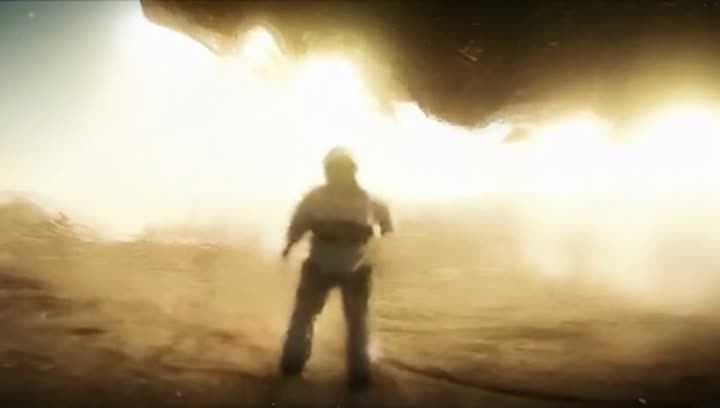
Video is likely
AI-made
Above: a frame from a Genmo Mochi clip in our test set, a man walking into a bright dust storm. Our video model scored it 99% AI. Dramatic, glowing scenes like this are the kind generators handle well, which is why a "divine light" over a temple or a face "appearing" in the clouds deserves a check before it's shared as real.
How to check a "miracle" clip
- Ask where and when. Which temple, which city, which day? A real event has a place. A clip with only "see this miracle" and no details is a warning sign.
- Look for other angles. At any festival or temple, hundreds of phones are recording. If something unusual really happened, you'd expect other videos from other people, and local news coverage. One perfect clip and nothing else is suspicious.
- Check the temple's own channels. Major temples and trusts often have official websites or social pages. If they say nothing about a remarkable event, that tells you something.
- Watch the details. In AI clips, look at the idol's ornaments and hands (do they change between moments?), the flames of diyas (do they flicker naturally?), the text on banners (does it spell real words?) and the crowd (do people merge or walk through each other?).
- Search the claim with "fact check". India's fact-checkers regularly look at viral religious claims. Our video fact-check page explains how published fact-checks are used in our results.
- Scan it for the AI signs people can't see.
Festival crowds and processions
Not every festival clip is about a miracle. Some AI clips show impossible scenes: a visarjan procession stretching to the horizon, a Kumbh crowd from an angle no drone could fly, or a city "decorated" in ways it never was. These are usually shared out of pride and are mostly harmless, but they can spread wrong ideas about crowd sizes or events.
Real festival videos have names: the mandal, the route, the ghat, the year. They also have ordinary imperfections: shaky phones, people blocking the view, loud and messy sound. AI festival clips tend to be perfectly lit and framed from impossible heights.
Be careful with money requests
Be wary of any devotional clip that ends with a QR code, a phone number or a request to "donate for the temple" or "book special darshan". If you want to give, use the temple's official website or counter, or a trust you already know. If you've been cheated, report it at cybercrime.gov.in or call 1930.
Sharing kindly in family groups
If you enjoy AI devotional art, share it as art. A simple "beautiful AI art" with the forward keeps it honest, and helps elders who might otherwise think it's real.
If someone in the family shares a "miracle" clip that turns out to be AI-made, keep your reply gentle. Their feeling is real even if the video isn't. Something like "This is a lovely video, but it was made with AI; here's the report" works far better than "fake". Our guide on verifying WhatsApp forwards has more ideas, and there's a Hindi guide on how to recognise AI videos to share with family.
Check a forwarded clip
Save the video from WhatsApp and upload it, or paste the original post's link, on our WhatsApp video checker. A Quick Scan is free, needs no sign-up and answers in under a minute for most videos. It shows the reasons behind the answer, and when the evidence is mixed it says "not conclusive" rather than guessing. On Android, you can install the site as an app and share videos straight to it from WhatsApp.
Quick answers
Is it wrong to make or share AI videos of gods?
That's a matter for each person's faith and conscience. From a fact-checking point of view, the only thing that matters is not passing off AI art as a real event.
How can I tell if a temple video is real?
Look for the place, the date and other people's videos of the same moment, check the temple's official channels, and scan the clip.
Does a detector judge the content of the video?
No. It only looks for signs that the video was made or changed by AI. It says nothing about faith or meaning.