India
Deepfake kya hota hai? Deepfake meaning, simply
Deepfake meaning in plain words, with a little Hindi: the main types (face swap, lip-sync, voice clone, full AI video), the harm they do and how to check one.
Video Verifier team · · 5 min read
A deepfake is a video, voice recording or photo made or changed with AI so that it looks real. Simple bhasha mein: AI se bana nakli video, jismein koi insaan woh kehta ya karta dikhta hai jo usne kabhi kiya hi nahi. The face can be fake, the voice can be fake, or the whole scene can be made up.
Where the word comes from
"Deepfake" joins two words: deep learning, the kind of AI that learns patterns from huge amounts of data, and fake. The term spread from an online forum in late 2017, where people were using AI to swap faces in videos. The meaning has widened since then. Today people call almost any AI-made video of a person a deepfake, even when no face was swapped.
Deepfake kitne tarah ke hote hain? The four main types
1. Face swap (chehra badalna)
One person's face is placed onto someone else's body in a real video. The room, the body and the movement are real; only the face is fake. This was the original kind of deepfake. It is still used for fake celebrity clips and, worst of all, for fake intimate videos made without consent.
2. Lip-sync (honth milana)
Real footage of a person, often from an interview or a speech, gets new audio, and the mouth is edited to match the new words. Everything looks normal except around the lips. Fake "endorsement" ads for trading apps often work this way.
3. Voice clone (awaaz ki nakal)
A copy of someone's voice made from a few seconds of their recordings. It can be used on its own, in a phone call or a voice note, or laid over a video. It's the hardest kind to catch by ear.
4. Fully generated video (poora AI video)
Nothing in it was ever filmed. Tools such as OpenAI's Sora, Google's Veo, Kling and Hailuo create the whole scene from a line of text or a single photo. Not everyone calls these deepfakes, but when they show a real person or an event that never happened, the harm is the same.
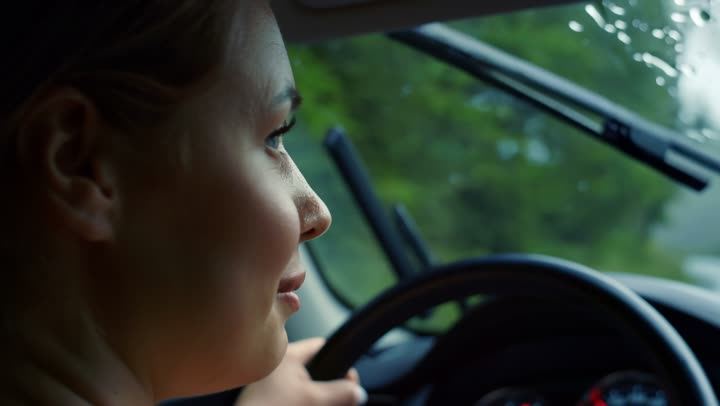
Video is likely
AI-made
Above: a frame from a clip made with Alibaba's Wanx tool. No one filmed this woman driving; the car, the window and the person were all generated. Our video model scored it 99% AI. On a phone screen, at scrolling speed, most people would never question it.
Deepfake se kya nuksaan hai? Why it matters
- Paise ka dhokha (scams). Fake videos of famous business leaders, cricketers or news anchors promoting "guaranteed return" schemes, and cloned voices of relatives asking for money urgently.
- Harassment. Morphed or fake intimate videos used to shame or blackmail people, most often women.
- Jhoothi khabar (misinformation). Fake speeches, fake "breaking news" clips, fake accidents and riots that never happened.
- The excuse effect. Once everyone knows deepfakes exist, someone caught on a real video can simply say "that's a deepfake". So checking matters in both directions: to expose fakes and to stand by real footage.
Not every AI video is harmful. Films, ads, memes and devotional art use AI openly, and that's fine. The trouble starts when a fake is passed off as real.
Deepfake kaise pehchane? Six checks
- Source dekho. Who posted it first? Is it on the person's official account or a trusted news site? A shocking clip that lives only in forwards and unknown pages deserves suspicion.
- Watch the mouth. In lip-sync fakes, the lips can look softer or blurrier than the rest of the face, and sounds like "p", "b" and "m" may not close the lips properly.
- Watch the edges of the face. In face swaps, look where the face meets the hair, ears, glasses and neck, especially when the head turns or a hand passes in front.
- Listen carefully. A voice that's too clean for the room, flat emotion, odd pauses or the wrong accent are all warning signs.
- Look for labels and watermarks. Some apps add an AI label, and some tools leave a small logo in the corner. A missing label proves nothing: labels get stripped and logos get cropped.
- Scan it. Paste the link or upload the file to a deepfake detector. Ours checks how the picture moves over time, the individual frames, the voice, visible AI watermarks and Content Credentials, then says "most likely AI-generated", "most likely real" or "not conclusive", with the reasons.
Hindi mein poori guide padhni ho to AI video kaise pehchane dekhiye, ya checker ko Hindi mein kholiye.
Honest limits
No checker is right every time, including ours. In an independent test in October 2026, using AI tools our model had never seen in training, it flagged 97% of 601 AI videos and read 96% of 84 real videos as real. That is strong evidence, not certainty, and heavily edited clips found "in the wild" are harder still. Treat a scan as one important piece of the picture, alongside the source checks above.
Agar aapka deepfake bana hai
If someone has made a deepfake of you, don't panic and don't pay anyone who demands money. Save the links and screenshots, report every copy to the platform, and file a complaint at cybercrime.gov.in or call 1930, the national cyber crime helpline. Our guide on what to do if someone made a deepfake of you walks through every step.
Quick answers
Deepfake ka Hindi meaning kya hai?
There's no single official Hindi word. Most people just say "deepfake", or describe it as "AI se bana nakli video ya awaaz".
Kya har AI video deepfake hota hai?
Not quite. "Deepfake" usually means AI media that imitates a real person, or a fake passed off as real. A clearly labelled AI cartoon isn't a deepfake in that sense.
Kya deepfake banana illegal hai?
Making a harmless, clearly labelled AI video is not a crime in itself. Using a deepfake to cheat, impersonate, harass or share intimate images without consent can be an offence under Indian law, and India's 2026 IT Rules require platforms to label AI content and act fast on some deepfakes.
Ek video check karke dekhiye
Got a clip you're unsure about? Paste the link or upload it on the home page. A Quick Scan is free to try, needs no sign-up and answers in under a minute for most videos.