Guides
Sora watermark removed? You can still tell
Sora's watermark takes seconds to crop or blur, and its clips are still re-posted everywhere. Signs a mark was removed, and the evidence a remover can't touch.
Video Verifier team · · 5 min read
Often, yes. The Sora watermark was only ever one clue, and removing it doesn't change how the video itself was made. A cropped or blurred corner, odd framing and a re-post with no original are signs a mark was taken off, and the motion and texture of the picture still carry the evidence a detector reads.
What the Sora watermark looked like
When OpenAI launched Sora 2 and its Sora app on 30 September 2025, it said every video carried a visible watermark: a small cartoon cloud logo with the word "Sora", which can move around the frame during a clip. OpenAI also said the files carried signed Content Credentials (C2PA), a hidden label naming the tool.
Neither lasted long in practice. A week after launch, 404 Media reported that watermark-removal sites were easy to find and that the ones it tried took the mark off in seconds. Content Credentials are usually stripped anyway when a video is uploaded to most social apps or screen-recorded.
According to OpenAI's help pages, as reported at the time, the Sora app and website closed on 26 April 2026. That doesn't make Sora clips disappear. Videos made while it ran are still saved on phones and re-posted on Reels, Shorts and WhatsApp, often without the mark.
Signs a watermark was removed
A remover has to hide something that may move around the frame, and that tends to leave traces. Look for:
- A smudge that travels. Some removers paint over the logo frame by frame. Pause in several places: a soft, blurry patch that sits where the logo would be, and jumps when it would jump, is a strong hint.
- A tight crop. Cropping in to cut the mark out loses the edges of the scene. Heads touch the top of the frame, hands are cut off, and the picture looks softer than it should because it has been enlarged.
- Stickers, emojis or captions in odd places. A big caption bar or a sticker stuck in one corner may be covering more than a corner.
- Black bars or a blurred copy of the video behind it. Re-framing a clip into a different shape is one way to push a mark off screen.
- A re-post with no history. The account didn't make the clip, can't say where it came from and posts many similar videos.
None of these means a video is AI-made: real clips get cropped and captioned all the time. They tell you a clue may be missing, so you should look for the others.
What a remover can't touch
Taking off a logo changes a small patch of the picture. It doesn't change the rest.
- Motion over time. AI video tends to move in ways real cameras don't: surfaces that slide over each other, details that drift, a camera that glides without a single shake. That's what our own video model follows from frame to frame, and it never looks for a logo.
- Physics and objects. Water, smoke, hair and cloth still behave a little wrongly. Objects still change shape when they pass behind something.
- Text. Signs, labels and number plates still turn into almost-words when you pause.
- Sound. Sora 2 could generate speech and sound effects with the picture. Voices that are too clean for the place and noise that resets at every cut are still there after the watermark is gone.
Video is likely
AI-made
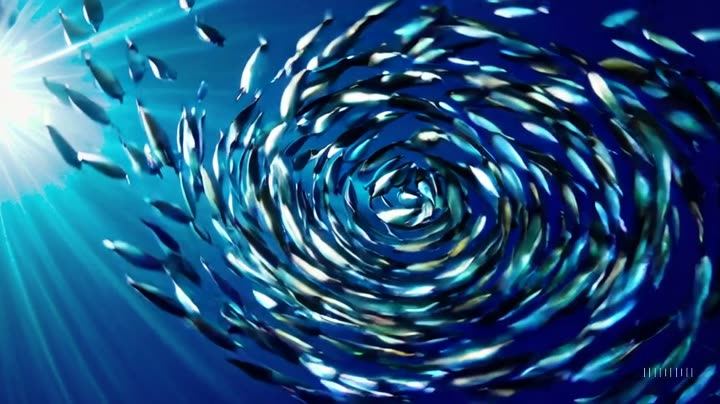
Above: a frame from an OpenAI Sora clip in our test set, a school of fish swirling. Our video model scored it 99% AI from the way the picture changes over time. It doesn't read logos at all, so a cropped or painted-over watermark doesn't change what it measures.
How well we catch Sora clips
We test on held-out clips our model never trained on, each checked in four versions: the original, a WhatsApp-quality copy, 360p and heavily compressed. On those, our model flagged 97.5% of OpenAI Sora clips as AI and wrongly called 0.8% of them confidently real. The Sora detector page has the details, and our accuracy page shows every tool, including the ones we find harder.
No detector is certain. The result is "most likely AI-generated" or "most likely real" with the reasons, or "not conclusive" when the evidence is mixed.
A five-minute routine for a suspected Sora clip
- Look at the corners and edges while pausing in a few places. Note any smudges, crops or stickers.
- Read the caption and comments. People often point out "this is Sora" or tag the original creator. Some creators label their own AI work, and that label gets lost in re-posts.
- Find the earliest upload. Take two or three screenshots and search them with Google Lens. The first copy may still have the watermark or an AI label. Our reverse video search guide walks through it.
- Check the file if you have the original. If someone sends you the file straight from the maker, it may still carry Content Credentials. Our explainer on Content Credentials covers what they show.
- Scan it and read the reasons, not just the headline number.
A word on removing watermarks
If you make AI videos yourself, leaving the watermark on, or saying clearly that a clip is AI-made, is the honest choice. Platforms have their own rules on labelling AI content, and a clip shared as a joke can be re-shared by someone else as real. Watermarks are one of the few signals ordinary viewers get. Our guide to AI video watermarks to look for covers the marks other tools use.
Got a clip with a suspicious corner?
Upload the file or paste the post's link on the home page. A Quick Scan is free, needs no sign-up and answers in under a minute for most videos. It reads visible marks like "Sora" when they're still there, any Content Credentials left in the file, and runs our video model either way.
Quick answers
Can you tell a Sora video without the watermark?
Often, yes. The watermark is one clue. Motion, physics, text and sound still carry evidence after it's gone, and that's what a detector reads.
Does a blurred corner prove a video is from Sora?
No. It suggests something was hidden. Real videos get blurred and cropped too, so check the other signs.
Is Sora still around?
Reports at the time said OpenAI closed the Sora app and website on 26 April 2026. Clips made earlier are still being shared.