Guides
Deepfake vs cheap fake: what's the difference?
A deepfake fakes the pixels; a cheap fake fakes the story around real footage. How to tell which one you're looking at, and which checks catch each kind.
Video Verifier team · · 4 min read
A deepfake is a video or voice made or changed by AI, so the pictures or sound themselves show something that never happened. A cheap fake is real footage made misleading with ordinary tools: a false caption, a cut, a speed change or a borrowed soundtrack. One fakes the pixels; the other fakes the story. They need different checks, and mixing them up is how people get fooled twice.
Where the two terms come from
"Deepfake" comes from "deep learning", the kind of AI that powers face swaps and video generators. "Cheap fake" was popularised by a 2019 Data & Society report by researchers Britt Paris and Joan Donovan, who pointed out that misleading video has never needed advanced technology: slowing a clip down, cutting it or relabelling it can do just as much damage. You'll also see "shallowfake" used for the same idea.
Side by side
- What's fake. Deepfake: the picture or the voice. Cheap fake: the context, meaning when, where, who or what it means.
- What it takes. Deepfake: an AI tool, often just an app and a few minutes. Cheap fake: a phone's built-in editor, or simply typing a new caption.
- What gives it away. Deepfake: visual and audio glitches, AI watermarks, missing camera history. Cheap fake: an older or longer version of the same footage somewhere online.
- What an AI checker should say. Deepfake: "most likely AI-generated". Cheap fake: usually "most likely real", and that's correct, because the footage is real.
- What actually catches it. Deepfake: AI detection, watermarks, Content Credentials and source checks. Cheap fake: reverse search, the full original, dates, places and fact-checks.
Video is likely
Real

Video is likely
AI-made
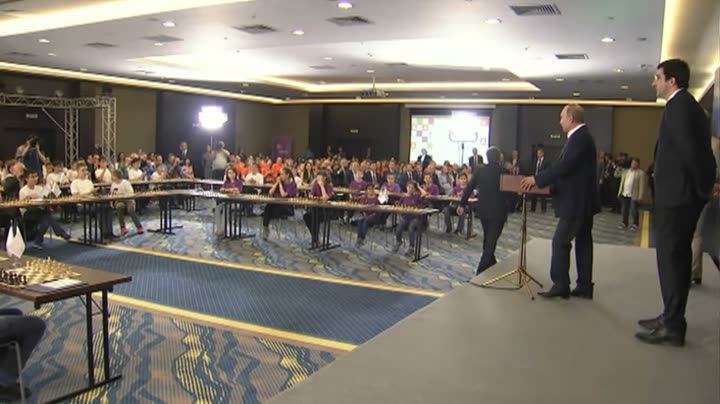
Two results from our test set. First: real footage of a conference hall from Wikimedia Commons, which our video model read as 99% real. Second: a family at a telescope at night, made with Kling 2.1 and scored 99% AI. If someone shared the conference clip with a made-up caption such as "emergency meeting called this morning", that would be a cheap fake, and our model would still, correctly, call the footage real. The telescope clip doesn't need a caption to be fake: nobody was ever there.
Five typical cases, sorted
- A real flood video from years ago, forwarded as "today in our city". Cheap fake: old footage, new caption.
- A politician's speech trimmed so one sentence means the opposite. Cheap fake: selective cut.
- A well-known actor "recommending" a trading app, using their real interview footage with a new voice. Deepfake: lip-sync plus voice clone.
- A building collapse that no camera ever filmed, made from a text prompt. Deepfake: fully generated video.
- A real crowd scene with angry chanting pasted on from another event. Cheap fake, unless the chanting itself was generated by AI, in which case it's both.
When it's both at once
The line is blurring. Watch out for these hybrids:
- Real video, cloned voice. The face and room are real; the words are not.
- AI clip, real-looking packaging. A generated scene with a copied news-channel logo and a "breaking news" caption.
- "Enhanced" real footage. Old or blurry clips run through AI upscaling, colourising or slow-motion tools. The event may be real, but the smoother picture can add details that were never there and may confuse automated checks.
Which check comes first?
Here's a simple order that works for both kinds:
- Check the claim before the pixels. If the caption says when, where or who, test that first with a reverse image search on a few frames. It's free, takes two minutes and catches most cheap fakes. Our reverse video search guide shows how.
- Then check the footage itself. If it looks or sounds slightly off, or the claim can't be traced, run an AI-generated video detector.
- Read the result for what it is. "Most likely real" means the footage is probably genuine, not that the caption is true. "Most likely AI-generated" means the scene probably never happened as shown, so the caption hardly matters. "Not conclusive" means lean harder on the source and on fact-checks.
- Look for a published fact-check. For links, our scan also looks up published fact-checks and known re-uploads of confirmed fakes, which helps when fact-checkers have already covered a cheap fake. If nobody has, the context check is yours to do.
Why both kinds still matter
It's tempting to think deepfakes are the "real" threat and cheap fakes are old news. In practice, cheap fakes are still everywhere because they cost nothing and need no skill. Deepfakes are growing because AI tools have become cheap too. A good habit covers both: ask "is this real footage?" and "is this what the caption says it is?" every time.
For a full list of editing tricks and how to spot each one, see is this video edited or out of context?
Quick answers
Is a cheap fake less dangerous than a deepfake?
Not necessarily. A real riot video with a false location can cause just as much panic as a generated one, and it's often more believable because every pixel is genuine.
Can an AI detector catch a cheap fake?
Not on its own, because the footage is real. A detector tells you whether the pictures and sound were made by AI. Whether the story is true needs a video fact-check: dates, places and the original source.
Is a face-swap filter on a funny video a deepfake?
Technically, yes. It only becomes a problem when someone presents it as real.
Check both halves
Next time a clip makes you angry or afraid, check the story with a reverse search, then check the pictures by pasting the link on the home page. A Quick Scan is free to try and needs no sign-up.