How it works
Why polished stock footage fools AI detectors
Our detector reads only 55.4% of polished stock clips as real. Why smooth, perfect footage looks AI-made to detectors, and how to read a result on that kind of video.
Video Verifier team · · 5 min read
Polished stock footage is the hardest kind of real video for AI detectors, ours included. In our tests, only 55.4% of real stock clips were read as real, against 96.5% of everyday real videos. The reason is simple: the things that make stock footage look expensive are the same things AI video generators are best at.
The numbers side by side
On our accuracy page, real videos are split into two groups:
- Everyday real videos, shared on Wikimedia Commons by hundreds of different people: 96.5% read as real.
- Polished stock footage from Pexels: 55.4% read as real.
Nearly half of the real stock clips were not read as real. That's our weakest result, and we publish it because it should change how you read a result on that kind of video. A detector that hides its false alarms leaves the people it wrongly accuses with no way to push back.
What makes footage look "too perfect"
Stock clips are made to be reused in adverts, presentations and explainer videos. To sell, they tend to share a look:
- Gliding camera moves. Gimbals, sliders and drones give smooth, floating motion with no handshake.
- Controlled light. Even, flattering lighting, often in a studio or at golden hour.
- Clean scenes. Tidy desks, perfect food, models who move calmly, nobody wandering through the back of the shot.
- Heavy finishing. Colour grading, noise reduction, stabilisation and sometimes slow motion, which smooth away the small flaws of a real camera sensor.
- Short, single-idea shots. A few seconds of one action, framed like a photograph.
Now think about what AI generators produce: short, smooth, cinematic shots with steady light and calm motion. The overlap is large.
Why that confuses a detector
Our own video model doesn't hunt for one tell. It follows how the picture changes from frame to frame and has learned the difference between the way real cameras record the world and the way generators build it. Everyday real footage is full of tiny irregularities: a hand that shakes, autofocus that hunts, exposure that jumps when someone walks past a window, grainy noise in the shadows.
Polished stock footage has had many of those irregularities removed on purpose. To a model that has learned "real cameras are a bit messy", a perfectly smooth real shot can look like a generated one. Read more about the idea behind the model in how our motion model works.
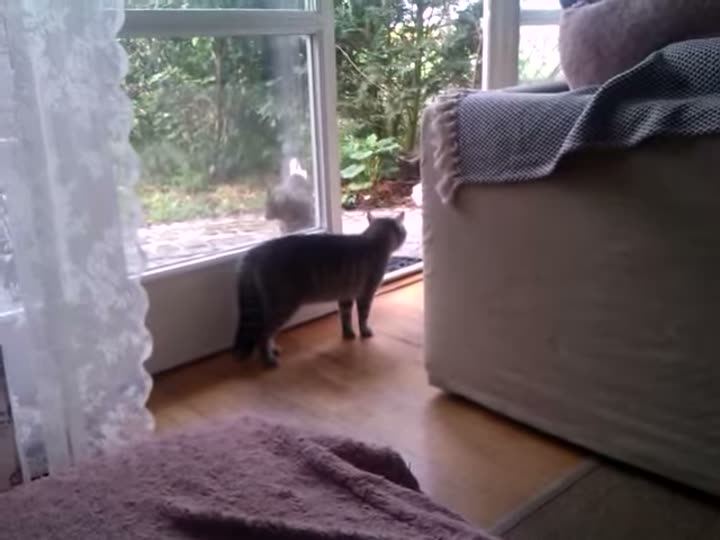
Below: two real clips from our test set. In the first card, a stock clip of hands typing on a laptop at a white desk, which our video model wrongly read as 99% AI. In the second, a cat looking out of a window, filmed by an ordinary uploader and shared on Wikimedia Commons, which it correctly read as 99% real. Both are real. One just looks like an advert.

Video is likely
AI-made
Video is likely
Real
How we keep the weak spot from doing damage
We can't make the problem disappear, but we can stop it from deciding a result on its own:
- No single check decides. The video model is one of several checks. A scan also reads Content Credentials, metadata and visible watermarks, checks the frames and the voice and, for links, the post itself. A language model weighs everything.
- Each check is shown separately. The report shows which check pointed which way, so you can see when an AI lean rests on the motion model alone.
- Uncertainty is allowed. When the evidence is split, the answer can say "Leaning AI, not conclusive" or "Too close to call" instead of forcing a yes or no.
- The weakness is public. It's on our accuracy page, on this page and in our post on when detectors get it wrong.
Reading a result on polished footage
If the video you're checking is an advert, a corporate film, a travel promo, a property walkthrough or anything shot on a gimbal or a drone, read an AI lean more cautiously:
- See which checks flagged it. A lean that comes only from the motion model is weaker than one backed by a watermark, an AI label in the post or a published fact-check.
- Check where it came from. A production company, a stock library or a brand's official channel is a different source from an anonymous viral account. Stock libraries usually show who shot a clip.
- Look for the rest of the shoot. Real productions leave other angles, behind-the-scenes clips and credits behind them. A single perfect clip with nothing around it is more suspicious.
- Run a Deep Scan when it matters. It checks every second of picture and the whole soundtrack, with up to 12× more frames than a Quick Scan.
The reverse also holds. A shaky phone clip from a "bystander" that comes back AI deserves more weight, because ordinary handheld footage is exactly what the model reads well.
If your own real video was flagged
Creators and brands sometimes run their own polished footage through a checker and get an AI lean. If that happens to you:
- Keep the original camera files, project files and raw footage. They're the strongest record of how a video was made.
- Where your camera or editing app supports it, publish with Content Credentials, so viewers can see how the file was made; see Content Credentials explained.
- Share behind-the-scenes clips of the shoot. Viewers find them reassuring, and they give anyone checking more to go on.
- Don't treat a single detector score as the final word, for you or against you. Detectors make mistakes in both directions.
Check it with the context in mind
Paste the link into our AI or real checker and read the evidence, not just the headline. For glossy footage, treat an AI lean as a reason to check the source, not as the end of the story.
Quick answers
Will a detector call my drone or gimbal video AI?
It might lean that way. Smooth, stabilised footage is what detectors find hardest. Keep your original files and look at which checks the report relied on.
Why not just fix the model?
We keep working on it, but there's a limit. The more polished a real video is, the less of the camera's natural roughness it carries, so some uncertainty on this kind of footage will remain.
Does this mean the detector is unreliable on all real videos?
No. On everyday real videos from hundreds of different uploaders, 96.5% were read as real. The weakness is specific to footage that has been smoothed and perfected.