How it works
Why AI videos look so real now
AI video went from melting faces to clips with believable light, motion and sound in about two years. What improved, why it fools us, and the tells that remain.
Video Verifier team · · 5 min read
AI videos look real now because the tools have learned from enormous amounts of real footage and can produce light, motion and sound together, not just pictures. Since early 2024, generators have gone from short, dreamlike clips to scenes with natural lighting, steady faces and matching speech. They still make mistakes, but the mistakes are smaller, rarer and easy to miss on a phone.
Here's what changed, why it fools people, and what still gives AI video away.
A quick timeline
A few public milestones show how fast this moved:
- February 2024: OpenAI showed Sora, which could turn a text description into a clip up to a minute long. The clips were silent.
- May 2025: Google announced Veo 3, which generated sound along with the picture: background noise, sound effects and dialogue between characters.
- September 2025: OpenAI released Sora 2, which it described as more physically accurate and more realistic than before, with synchronised dialogue and sound effects.
Alongside these, tools like Kling, Hailuo, Runway, Luma, Pika, PixVerse, Seedance and Wan improved quickly. Some, like Alibaba's Wan 2.1 and Tencent's HunyuanVideo, were released openly, so anyone with a powerful enough computer can run them. The result is that convincing clips are now cheap, fast and common.
What got better
Light
Early AI video often had flat or impossible lighting. Today's tools handle sunsets, neon, firelight and night skies convincingly, with reflections and soft shadows. Lighting is a big part of what makes a scene feel real, so this improvement matters a lot.
Faces
Faces used to drift: an eye would wander, teeth would blur, a person would slowly become someone else. Faces now usually stay stable for the length of a typical clip, with believable skin and expressions. Small faces in the background are still weaker than the main one.
Motion
Walking, running, waves and smoke look more natural. Generators are better at keeping objects solid as they move, though they still struggle with complex contact, like hands working with tools or a ball bouncing off a surface.
Sound
This may be the biggest recent change. A silent clip is easy to doubt. A clip where a person speaks, traffic hums and a door slams at the right moment feels real in a way pictures alone don't. Generated voices with matching lips remove one of the most reliable old tells.
Camera style
Tools can now imitate the look of specific cameras: a shaky phone, a dashcam, a CCTV feed, a news broadcast. Because we trust those formats, a fake that copies them borrows their credibility.
Why it fools us
The tools improved, but so did the conditions that help them:
- Small screens. Fine detail that would give a clip away on a monitor is invisible on a phone.
- Scroll speed. We judge a video in a second or two, which is where AI looks its best.
- Compression. Every upload and forward throws away detail, smoothing over the subtle errors that remain. Our guide to why re-uploads make fakes harder to catch explains how.
- Captions. A caption tells us what we're seeing before we've looked. We tend to see what we've been told.
The tells that remain
AI video still has weak spots. They just take more patience to find.
- Cause and effect. A glass falls but doesn't break, or breaks before it lands. Footprints don't appear in sand.
- Things that should stay the same. Patterns, text and the number of objects can drift over a clip.
- Crowds and background people, who may stutter, merge or walk without moving forward.
- Text and logos, which are still often garbled.
- Sound that is too clean, or that doesn't change when the speaker turns or moves.
- Short takes. Many clips are still only a few seconds long, so longer "continuous" footage may be stitched from several clips.
Our guide to what AI video still gets wrong goes through these with examples.
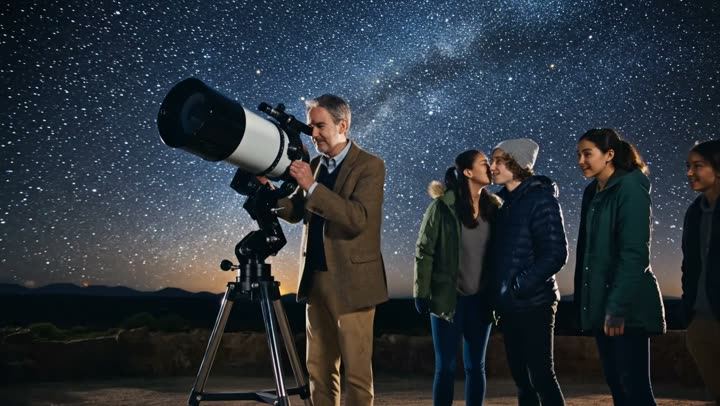
Below is a frame from a clip of people gathered around a telescope under the Milky Way, made with Google Veo 3. A scene like this, with low light, a starry sky and several people, would have been a stretch for early generators. Our video model still scored it 99% AI, because it judges how the picture changes over time, not how good a single frame looks.
Video is likely
AI-made
How detectors keep up
Detectors look for things people can't see. Our own video model follows how a video's content moves from frame to frame. Real footage tends to follow a straighter, steadier path through time, while generated video bends and jitters more, even when every frame looks perfect. The idea comes from research on how the brain processes natural video, explained in our post on perceptual straightening. Each scan adds a frame model, a voice model, watermark reading, Content Credentials and, for links, the post's caption and published fact-checks.
That approach holds up well, but some tools are measurably harder to catch. Across our held-out test clips from Google's Veo family, our model flagged 88.9% as AI, and wrongly called 2.3% confidently real. For OpenAI's Sora it flagged 97.5%. We publish the full per-tool numbers on the Veo and Sora pages and on our accuracy page.
What this means for you
You can't rely on "it looks real" any more, and you can't rely on "it has sound" either. What still works:
- Check who posted it and whether anyone else filmed the same event.
- Look for the remaining tells, slowly, on the biggest screen you have.
- Scan anything that matters before you share it.
Not sure about a clip? Paste it into the AI or real checker. A Quick Scan is free to try, needs no sign-up, and answers in under a minute for most videos.
Quick answers
Can AI videos have real-sounding voices now?
Yes. Several generators produce speech and sound with the picture, and voice cloning tools can copy a real person's voice. A believable voice is no longer evidence that a video is real.
Will AI video become impossible to detect?
Nobody can promise either way. Detection keeps improving too, and checks that don't depend on the picture, like the source, Content Credentials and fact-checks, will stay useful.