Guides
Talking to kids about AI videos
How to explain AI videos to children at every age, turn spotting fakes into a game, build good habits, and talk to teenagers about deepfakes of real people.
Video Verifier team · · 5 min read
Explain AI videos to children the way you'd explain cartoons or special effects in films: computers can now make videos that look real, so we check before we believe or share. Keep it calm and curious rather than scary, match the conversation to their age, and practise together with real examples. Children who learn to ask "who made this, and why?" are better protected than children who are simply told to be afraid.
Start with what they already know
Most children already understand that films use special effects and that cartoons aren't real. Build on that. "You know how the dinosaurs in films aren't real dinosaurs? Computers can now make videos of anything, people and animals too, and some of them look completely real."
Then add the one idea that matters: some people make these videos to trick others. Not all AI videos are bad. Many are made for fun or art. The problem is when someone pretends a made-up video is real.
Ages 5 to 8: "real or made-up?"
At this age, keep it simple and playful.
- Watch a few short videos together and ask, "Do you think this really happened, or did someone make it up?" There's no wrong answer; the point is to ask the question.
- Use words they know: "pretend", "made-up", "computer-made". Avoid "fake news" and "deepfake" for now.
- Praise the question more than the answer. "Good thinking, let's find out" is the habit you want.
- Keep it light. If a video upsets them, focus on comfort first and explanations later.
Ages 9 to 12: become a detective
Older children enjoy spotting clues, so give them some.
- Watch the hands and the text. AI often gets fingers, signs and writing slightly wrong.
- Follow one thing. Pick an object, like a ball or a hat, and see if it changes during the clip.
- Ask who posted it. A real news channel? A stranger? An account full of amazing animal videos?
- Ask why. Is the video trying to make you laugh, scared, angry or buy something?
Then make it a game. Our Real or AI quiz shows real clips and AI clips from our test set, and children can compete with parents and siblings. If the grown-ups get a few wrong too, that's part of the lesson: anyone can be fooled, so everyone checks.
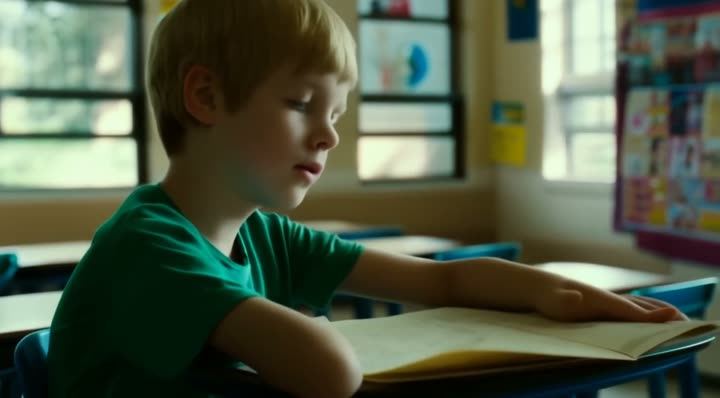
Video is likely
AI-made
Above: a boy reading a book at a desk in a classroom, from a clip made with Luma Dream Machine. Our video model scored it 99% AI. Show it to your child and ask: "If someone said this was a boy from your school, how could we check?" There's no school, no boy and no book.
For older children who like details, our list of what AI video generators still get wrong makes a good detective checklist.
Teenagers: real people, real harm
With teenagers, the conversation shifts from "spot the fake" to respect and consent, because the most painful AI videos are made of real people they know.
- Talk about deepfakes of classmates. Apps can put a real person's face on a fake video, including sexual ones. Be clear: making or sharing a fake intimate image of someone is deeply harmful, and it can be a crime, even as a "joke".
- Talk about consent. Using someone's face or voice without permission isn't a prank when the person can't stop it spreading.
- Talk about their own photos. Public photos and voice notes can be copied. That's not a reason for fear, but it is a reason to keep accounts private and think before posting.
- Make sure they know they can come to you. If someone makes a fake of them, or threatens to, they need to know you'll help rather than punish. Say it out loud.
If a fake intimate image of a child is being shared, report it at cybercrime.gov.in, which has a route for crimes against women and children, or call 1930. Take It Down, a free service run by the US National Center for Missing & Exploited Children, helps stop the spread of explicit images taken of someone under 18 on participating platforms, without uploading the image itself. Our guide on what to do if someone made a deepfake of you covers the rest.
Four habits to practise together
- Pause. If a video makes you feel a big feeling, wait before sharing.
- Ask who and why. Who made this? Why do they want me to see it?
- Check. Look for the same story somewhere trustworthy, or scan the video together.
- Share kindly. If a friend shares a fake, tell them privately. Everyone gets fooled sometimes.
Show, don't just tell
Children copy what you do. Let them see you check a video before forwarding it in the family group. If you were fooled by something, say so: "I believed this at first, then I found out it was AI." It teaches them that checking is normal and being wrong is fine.
You can also show older children how a video detector reaches its answer. Our report lists the evidence behind a result, and it says "most likely" rather than claiming to be certain. That's a useful lesson in itself: good checkers are honest about what they don't know.
Quick answers
At what age should I start talking about AI videos?
As soon as your child watches videos on their own. Keep it to "real or made-up?" for young children and add detail as they grow.
Should I ban AI apps?
That's a family decision. Many AI tools are creative and fun. What matters more is that children know AI videos can mislead, and that they come to you when something feels wrong.
My child believes a fake video. What do I do?
Don't laugh or scold. Look at it together, check it together, and praise them for asking.
Try it together
Pick a video your child has seen recently and check it together on the home page. The Quick Scan is free to try and needs no sign-up, and the report explains its reasons in plain words.