Guides
AI travel videos: is that place real?
Dream resorts, hidden waterfalls and attractions that don't exist: how to check whether a place in a travel video is real before you plan a trip or pay.
Video Verifier team · · 5 min read
Some of the most beautiful travel videos online show places that don't exist: a cliff-edge infinity pool, a "hidden" waterfall, a new cable car over the forest. To check a place, look it up on a map with other people's photos, search for official and news sources, and find the video's first upload. If a place has only one video and no reviews, be very careful, especially before paying anything.
A trip to a cable car that wasn't there
In mid-2025, an elderly couple in Malaysia travelled more than 300 km from Kuala Lumpur to Kuak Hulu, a village in Perak, to ride a cable car they had seen in a video. The video looked like a TV news report, with a presenter, tourists being interviewed and views from the cable car. None of it was real: the presenter, the tourists and the "Kuak Skyride" were AI-generated, and local officials confirmed there was no such project (Malay Mail reported the story).
It's a gentle example: they lost a journey, not their savings. But it shows how convincing a fake place can be when it comes in a familiar format, like a news report.
The fake places you'll meet
- Dream stays. Resorts, treehouses, glass cabins and pools with impossible views, often linked to a booking page or a phone number.
- "Hidden gems." Waterfalls, caves and lakes "that nobody knows about", usually with a vague location such as "somewhere in the Northeast".
- New attractions. Bridges, cable cars, theme parks and viewpoints claimed to have "just opened".
- Enhanced real places. A real hill station or beach, made bigger, emptier, more colourful, or with a waterfall added. These lead to real places that look nothing like the video.
Two clips: one invented, one real
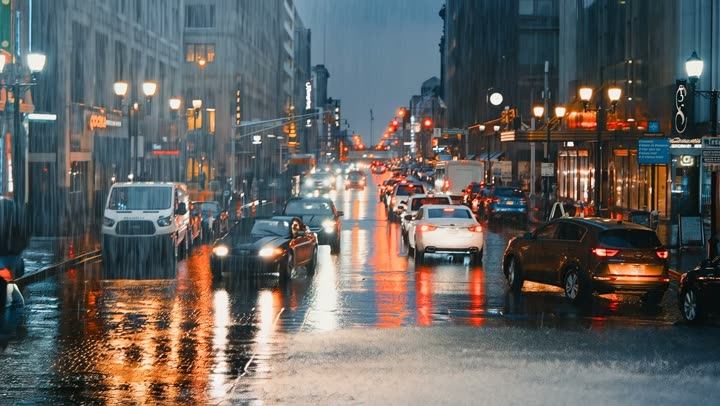
Video is likely
AI-made
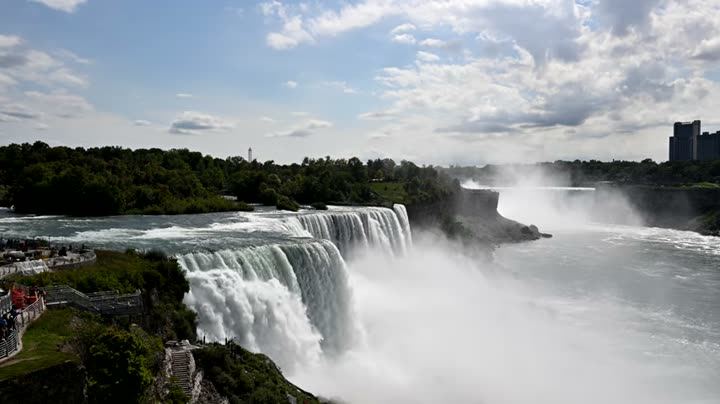
Video is likely
Real
First card: an AI clip made with Hailuo 02, a rainy city street at dusk with cars and reflections. It isn't a real street; our video model scored it 99% AI. Second card: a real video of Niagara Falls seen from above, by G. Edward Johnson on Wikimedia Commons; our model read it as 99% real. Both are atmospheric and both could be in a travel reel. Only one is a place you can find on a map.
How to check if a place exists
- Get the exact name. A real place has a name, a district and usually a PIN code or nearby town. "Somewhere in Himachal" is not a location. Check the caption, the comments and any text in the video.
- Search it on a map. Look for the place on Google Maps or another map app, then open the photos other visitors have added, and Street View where available. Compare them with the video: the shape of the hills, the buildings, the road.
- Read reviews and their dates. A real resort has reviews over months or years, with ordinary, imperfect phone photos. A place with no reviews, or only glowing ones posted in the same week, is a warning sign.
- Look for official and news sources. New attractions are usually announced by the operator, the local authority or the state tourism department, and covered by local news. If the only source is a reel, be suspicious.
- Find the first upload. Take screenshots of a few distinctive frames and search them with Google Lens. You may find the original creator labelling it as AI art, or a real place in a different country. Our reverse video search guide walks through this.
- Check the account. Is it a travel page that posts a new "paradise" every day from different countries, with no faces, no stories, no behind-the-scenes? Real travellers post the queue, the rain and the bad hotel too.
Signs in the video itself
- Text that doesn't read. Signboards, shop names and menus that are almost words.
- People in the background who walk in loops, merge or have no faces.
- Water that doesn't behave. Waterfalls that flow but never splash, waves that roll without reaching the shore.
- Perfect conditions every time. Golden light, no crowds, no litter, no wires, in every single shot.
- A gliding camera. Smooth, drone-like movement through spaces a drone couldn't fly through.
Our 12 signs of AI video covers more. And a word of fairness: some real places look unreal, and skilled photographers make them look more so. Unusual isn't fake. That's why the map and the reviews matter more than your first impression.
Before you pay a deposit
Fake places are sometimes attached to booking scams: a stunning video, a "limited offer", and a request to pay an advance by UPI to a personal account.
- Book through platforms you know or the property's own website, found independently, not through the link in the video.
- Call the property on a number listed on the map or on a known booking site.
- Be wary of pressure. "Only two rooms left, pay now" is a classic push.
- If you've been cheated, report it at cybercrime.gov.in or call 1930 in India, as soon as possible.
Scan the reel
If a destination video seems too perfect, paste its link into our Instagram video checker or upload the file on the home page. A Quick Scan is free, needs no sign-up and answers in under a minute for most videos. It shows the evidence behind its answer, and says "not conclusive" when the signals are mixed. A scan tells you whether the video looks AI-made; only the map, the reviews and official sources tell you whether the place exists.
Quick answers
How do I know if a resort in a video is real?
Find it on a map, look at visitors' own photos and reviews over time, and book only through channels you can verify.
Can a real place appear in an AI video?
Yes. AI can make a video of a real place, often looking better than it does in life. Compare it with visitors' photos.