Scams and safety
AI influencers and UGC ads: is that person real?
AI presenters now star in product videos and “customer reviews”. How to tell if the person in an ad is real, what disclosure to expect, and how to check the clip.
Video Verifier team · · 5 min read
The cheerful person telling you about a face serum, a trading app or a weight-loss drink might not exist. AI tools can now generate a convincing presenter who talks to camera, holds up a product and looks just like an ordinary customer filming a review on their phone. Some brands use them openly. Others use them to fake testimonials. Here's how to tell the difference, and why it matters.
Three kinds of AI people in ads
- Virtual influencers. Computer-generated characters with their own accounts and followers. The well-run ones are open about being virtual.
- AI presenters and avatars. Generated or cloned "spokespeople" reading a script, common in explainer videos and low-budget ads.
- Fake "real customers". AI-generated people styled like user-generated content (UGC): a selfie angle, a casual room, "I tried this for 30 days and...". This is the kind that misleads, because the whole point of UGC is that a real person is vouching for the product.
An AI presenter isn't automatically a scam. And a fake customer review is misleading whether the "customer" is AI or a paid actor. The real question is whether you're being told the truth about who's speaking.
What disclosure should look like
In India, the Advertising Standards Council of India's guidelines for influencer advertising say virtual influencers should tell audiences upfront that they aren't real people, and that paid posts should carry a clear label such as "Ad", "Sponsored" or "Collaboration". Platforms also add their own AI labels to some content. Our explainer on India's rules for AI labels and deepfakes covers the legal side.
In practice, labels are often missing, tiny or buried at the end of a caption. Don't rely on them alone.
Clues the person might be AI-made
Short ad clips are where AI presenters look most convincing, so look at several clues together rather than one:
- The same framing every time. Same angle, same light, same background in every video, even ones supposedly filmed weeks apart.
- Looping gestures. A small set of nods, hand movements and head tilts that keep repeating.
- Mouth and teeth. Lips that look slightly soft or out of time with the words; teeth that blur into a single white band.
- Hands and the product. Fingers that merge into the bottle; label text that shifts or doesn't quite form words.
- A voice that's too even. No breaths, no stumbles, the same energy in every sentence. Cloned voices are hard to judge by ear; our AI voice detector page explains what a voice check can and can't do.
- No life outside the ad. Real creators have older posts, replies to friends and photos tagged by other people. Invented ones tend to appear from nowhere.
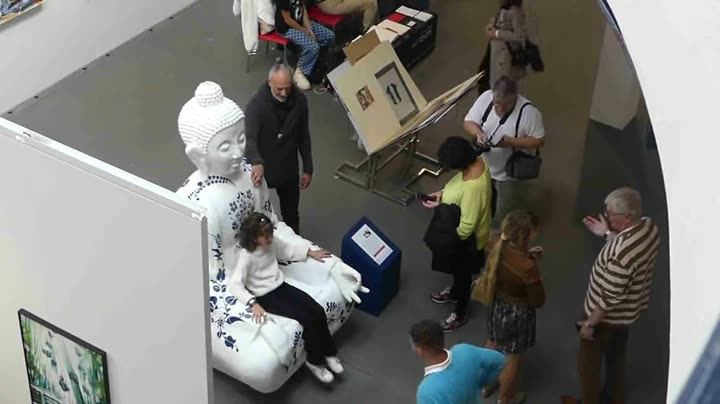
In the first card below: a woman in sunglasses taking a selfie, generated with Google Veo, which our video model scored 99% AI. That phone-in-hand selfie angle is exactly the casual look UGC-style ads copy. In the second: a real Wikimedia Commons clip of museum visitors around a statue, filmed from above, read as 99% real. Real scenes carry plenty of unplanned detail around the main subject, and that surrounding detail is worth studying in any ad.

Video is likely
AI-made
Video is likely
Real
How to check a product video
- Find who's behind it. Tap through to the account or page that posted the ad. How old is it, and what else does it post? On Facebook and Instagram, Meta's Ad Library lets you see the other ads a page is running.
- Search for the presenter. Do they exist outside this ad? Search their name or handle. Someone introduced as a doctor or an expert should be findable with real credentials, on the official register for their profession where one exists.
- Check the claims, not just the face. Even a real person can say false things. "Guaranteed returns", "cured in 7 days" and "government-approved" each deserve their own check.
- Look for the same face elsewhere. If the same presenter is selling unrelated products for unrelated brands, it may be a stock AI avatar.
- Scan the video. Paste the ad's link or upload a saved copy. A scan looks at the motion, the frames, the voice, visible watermarks and hidden labels and, for links, the post's caption and tags.
When it becomes a scam
AI presenters and deepfaked celebrities turn up most often in ads for get-rich-quick investments, miracle health products and fake giveaways. If an AI-made "customer" or a famous face is pushing you to pay, install an app or join a group, stop and check. Our guide to deepfake investment ads explains the usual pattern. In India, report fraud at cybercrime.gov.in or call 1930.
If your brand uses AI presenters
Be upfront. A clear "AI-generated presenter" line costs nothing, while customers who find out later feel misled, and that costs a lot more. Don't present an AI character as a real customer, and don't give it qualifications it doesn't have.
Check the ad before you buy
Copy the ad's link and paste it on the home page. A Quick Scan is free to try and needs no sign-up. For more on clips from Google's video tools, see our Veo page.
Quick answers
Can brands use AI influencers in India?
Advertising guidelines in India expect clear disclosure that an influencer is virtual and that a post is paid. For specific legal questions, ask a lawyer.
Can a detector tell if a presenter is AI?
Often, when the whole video is generated. It's harder when a real person's face or voice has been changed in parts; a Deep Scan breaks the result down into real, real + AI and fully AI.
Is every polished ad AI?
No. Professional ads are smooth and well lit by design, and that polish can make real footage look AI-like to people and detectors alike. Look at the evidence, not the gloss.