Guides
Too-perfect food videos: real or AI?
Endless cheese pulls, steam that swirls on cue, slices that heal themselves: how to tell AI food videos from real cooking reels and polished food ads.
Video Verifier team · · 4 min read
AI food videos are easy to make and easy to believe: a cheese pull that never breaks, a cake sliced to show perfect layers, sizzling street food under golden light. You can often spot them by watching what food does when it's cut, poured or lifted, and by watching the hands. But "too perfect" alone isn't proof, because real food ads are polished too, and that's exactly where checks, ours included, need the most care.
Where AI food videos turn up
- Recipe reels from pages that post several "easy dinners" a day, with no voice, no face and no kitchen you see twice.
- Satisfying clips: slow cuts, crunchy bites, chocolate pours, honey dripping, often with crisp sound.
- Street food and "giant" food: a two-metre paratha, a tower of pani puri, a dosa that wraps a table.
- Restaurant and cloud-kitchen ads where the dish on screen may look nothing like what arrives.
- Product ads for snacks, sauces and appliances.
Watch what the food does
Generators know what food looks like. They're much worse at what it does.
- Cutting. Watch the knife go in. Does it meet resistance, or slide through like air? Do the slices match what the outside promised, or do the layers inside change as the cut goes on? Sometimes a cut closes up again.
- Pulling and stretching. Cheese that stretches forever, never thins and never snaps; noodles lifted from a bowl that keep coming.
- Pouring. Liquid that pours without splashing, a glass that fills faster than the stream could manage, or a bowl that fills to the brim from one ladle.
- Steam and smoke. Real steam is messy and drifts with the air. AI steam can rise in neat, even curls, or appears and disappears without a source.
- Quantities. Ingredients that appear from nowhere, a pan that holds more than went in, a plate that is full again a second later.
- Bites. Teeth marks that don't match the bite, or a sandwich that looks untouched after a mouthful.
Then watch the hands and tools
Cooking means hands, and hands are still where AI slips.
- Fingers that merge with dough or disappear into the food.
- Utensils that change shape: a spatula that bends, a knife that becomes a spoon, a pan handle that moves.
- Grip that makes no sense: a heavy pot held by two fingers, a knife held without pressure.
- Labels on jars and packets that don't spell anything when you pause.
Video is likely
AI-made
Video is likely
Real
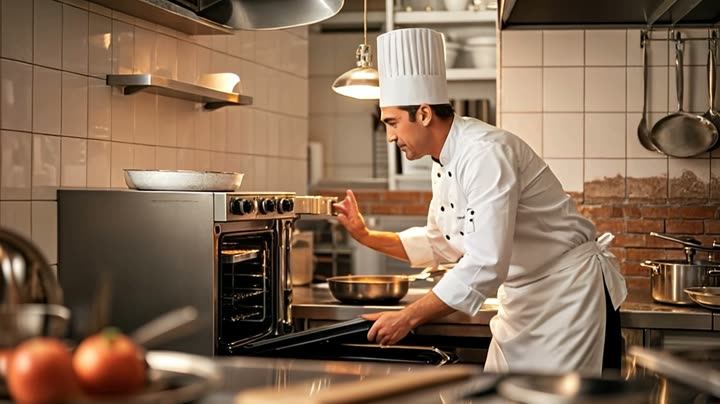
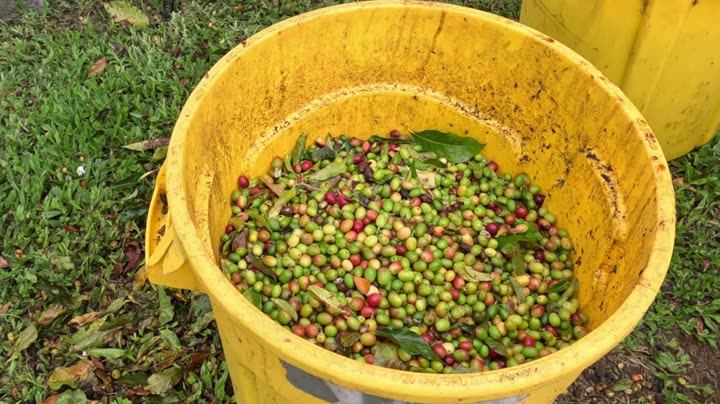
First card: a ByteDance PixelDance clip of a chef cooking in a restaurant kitchen, from our test set; our video model scored it 99% AI. Second card: a real video of a bucket of freshly picked coffee cherries, by AlexanderKlink on Wikimedia Commons; our model read it as 99% real. Real food footage is often a little messy: uneven light, imperfect produce, a busy background. That ordinariness is itself a clue.
Polished isn't the same as AI
Professional food filming has always used tricks: careful lighting, styling, and many takes to get one perfect pour. A glossy ad can be completely real footage of a very carefully prepared dish.
This matters for detectors too. Our video model's weakest case is polished stock footage: on real videos from a stock library, it read only 55.4% as real, because very smooth, perfectly lit footage can look AI-like. On everyday real videos it read 96.5% as real. So a glossy food ad is exactly where you should read the reasons behind a result, not just the headline. We publish this on our accuracy page so you know when to double-check.
Is the ad misleading, or is the video fake?
Two different questions:
- Is the video AI-made? A scan and the checks above help.
- Does the food look like what you'll get? That's about the seller, not the pixels. Look at customers' own photos in reviews on delivery apps and maps. If every customer photo looks very different from the ad, you have your answer, whatever made the video.
Recipe reels: will it actually work?
An AI recipe video can show steps that would never work in a real kitchen: batter that sets in seconds, bread that rises instantly, quantities that don't add up. Before you cook from a reel:
- Check the account. Does a real person cook on camera, speak, make mistakes? Do they post the same kitchen over time?
- Read the comments for people who tried it.
- Compare with a written recipe from a cook or site you trust.
If you're watching on YouTube, our YouTube video checker takes the link directly, and our guide to what AI video generators still get wrong covers the physics errors that show up in cooking clips.
Check a food reel
Paste the link into our Instagram video checker, or upload the saved file on the home page. A Quick Scan is free, needs no sign-up and answers in under a minute for most videos. It runs our own video model, which follows how the picture moves over time, a frame check and visible AI watermark reading, and shows the evidence behind the answer: "most likely AI-generated", "most likely real", or "not conclusive" when the signals disagree.
Quick answers
Why do AI food videos look so good?
Generators learn from huge amounts of images and video, and beautifully shot food is everywhere online, so the look of perfect food comes easily to them. They're weaker at physics: cutting, pouring, stretching.
Is every glossy food ad AI?
No. Professional food filming uses lighting, styling and many takes. Polished real footage can even look AI-like to detectors, which is why the reasons behind a result matter.