How it works
Kling, Hailuo, Wan, Seedance: tools behind viral AI clips
Who makes Kling, Hailuo, Wan and Seedance, why their clips fill Reels and Shorts, the marks they leave, and how often our detector catches each one.
Video Verifier team · · 4 min read
Sora and Veo get the headlines, but many AI clips on Reels, Shorts and WhatsApp come from tools plenty of people have never heard of: Kling, Hailuo, Wan and Seedance, made by Chinese tech companies, some of them among the country's biggest. They're popular partly because they're cheap or free to start, fast, and good at dramatic motion. In our tests, our detector flags most of their clips, with one clear weak spot: Hailuo 02.
Who makes them
Kling, by Kuaishou. Kuaishou runs one of China's largest short-video apps. It released Kling for public testing in June 2024 and opened it to users outside China a month later. Versions 1.5, 1.6, 2.0 and 2.1 followed within a year, and newer ones since.
Hailuo, by MiniMax. MiniMax, a Shanghai AI company, launched Hailuo's video generator in September 2024. It quickly became popular for short, lively clips. Hailuo 02 arrived in June 2025, with newer versions after it.
Wan, by Alibaba. Alibaba first announced its video model as Wanx, then shortened the name. In February 2025 it released Wan 2.1 as an open model: anyone can download it, and the smallest version runs on an ordinary gaming graphics card. Wan 2.2 followed.
Seedance, by ByteDance. The company behind TikTok and CapCut released Seedance 1.0 in June 2025. It powers video generation in ByteDance's Jimeng (即梦) app in China and Dreamina internationally. ByteDance has also built other video models, including Seaweed and PixelDance.
Others in the same family of tools include Tencent's HunyuanVideo, Zhipu's Qingying (built on its CogVideoX models), Vidu from ShengShu Technology and Tsinghua University, and PixVerse.
Why their clips spread so far
- Low cost. Free credits or cheap plans make it easy to produce dozens of clips a day, which suits pages that farm views.
- Speed. A short clip can be ready in minutes, so trends get copied while they're still hot.
- Photo to video. Most of these tools can bring a single photo to life, so a real photo of a person, place or animal becomes a "video" of it.
- Dramatic motion. Several of them are good at fast action: stunts, chases, animals leaping, disasters. That's what stops a thumb mid-scroll.
- No watermark, sometimes. Wan run on someone's own computer adds no mark at all, and paid plans on other tools can export without one.
The marks they leave
Clips made in these tools' own apps often carry a visible mark when they're first saved. Look for "Kling AI" or "可灵", "Hailuo AI" or "海螺AI", Jimeng or Dreamina, Tongyi Wanxiang (通义万相), or a plain "AI生成" ("AI-generated"). China's rules on labelling AI content, in force since September 2025, require services there to add visible labels, so clips saved from Chinese apps are more likely to carry one. Re-posts often crop them out.
Beyond marks, the shared tells are familiar: short clips stitched together, bodies that bend wrongly in fast motion, background people who blur or loop, and text that almost reads.

Video is likely
AI-made
Video is likely
AI-made
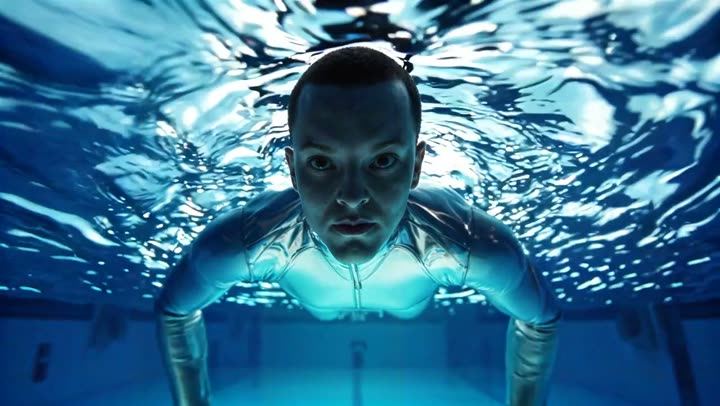
Above: a MiniMax Hailuo clip of footballers chasing the ball on a grass pitch, and a ByteDance Seaweed clip of a man floating underwater. Both are from our test set, and our video model scored each 99% AI. Fast sport and underwater scenes are hard to judge by eye, so clips like these can pass at scrolling speed.
How often we catch them
These are the shares of held-out test clips our model flagged as AI, and the shares it wrongly called confidently real. Each clip was checked in four versions: the original, a WhatsApp-quality copy, 360p and heavily compressed.
- Kling (1.5, 1.6, 2.1): 96.8% flagged, 0.5% wrongly called real.
- Hailuo, first model: 95.1% flagged, 1.5% wrongly called real.
- Hailuo 02: 84.8% flagged, 5.4% wrongly called real. One of our weaker results, and we say so.
- ByteDance (Seaweed, Seedance, PixelDance): 95.3% flagged, 1.4% wrongly called real.
- Alibaba Wan: 96.0% flagged, 1.0% wrongly called real. In a separate independent test in October 2026, it flagged 98.2% of Wan 2.2 clips.
- Vidu: 95.6% flagged, 1.6% wrongly called real.
- Tencent HunyuanVideo: 91.7% flagged, 1.3% wrongly called real.
- CogVideoX / Qingying: 92.6% flagged, 1.7% wrongly called real.
- PixVerse: 98.1% flagged, 0.2% wrongly called real.
Newer versions of these tools come out often, and not every version was in our test. Our video model doesn't need to know which tool made a clip: it follows how the picture changes over time. That's how it flagged 96.2% of clips from NVIDIA's Cosmos-Predict 2.5, an AI family it never saw in training. Still, every result is evidence, not proof. Full figures for every tool are on our accuracy page.
Tool pages
Each tool has its own page with its signs, marks and our numbers: Kling, Hailuo, Wan and Seedance.
Not sure what made a clip?
You don't need to know the tool. Upload the file or paste the link on the home page. A Quick Scan is free, needs no sign-up and answers in under a minute for most videos. It reads any visible mark it finds, such as "Kling AI" or "AI生成", runs our video model and frame check, and explains its answer: "most likely AI-generated", "most likely real", or "not conclusive" when the evidence is mixed.
Quick answers
Is every video made in CapCut AI-generated?
No. CapCut is mostly an ordinary editor. Cuts, filters, captions and music don't make a video AI-generated; only its AI video features generate footage.
Why don't Wan videos have watermarks?
Wan is an open model. People run it on their own computers, and nothing forces it to add a mark.
Which of these tools is hardest to detect?
Among these, Hailuo 02 had the lowest share flagged in our tests. Across all the tools we measured, Luma Ray 2, Moonvalley Marey and Google Veo were also among the hardest.