Guides
Lip-sync deepfakes: how to spot fake words in a real video
Lip-sync deepfakes put new words in a real person's mouth. How they work, where they show up (scam ads, fake speeches, dubbing) and the signs around the mouth that give them away.
Video Verifier team · · 3 min read
Have a video to check right now? Run a free check on crackly-ai.com →
A lip-sync deepfake takes a real video of someone, gives it new audio, often a cloned voice, and redraws the mouth to match the new words. The face, the room and the gestures are genuine, so it passes a quick look. The giveaways are around the mouth: lips that look softer or blurrier than the rest of the face, sounds like "p", "b" and "m" that don't close the lips, teeth that smear, and a voice whose emotion doesn't match the expression.
Where lip-sync fakes show up
- Scam ads. A real interview with a business leader, cricketer or news anchor, re-voiced to promote a "guaranteed return" trading app. See deepfake investment ads.
- Fake speeches and statements. A politician or official "saying" something they never said, built from a real press conference.
- Translations and dubbing. Legitimate tools now re-voice videos into other languages and adjust the lips. These are fine when labelled, but the same technology is used without disclosure.
Six signs of a lip-sync deepfake
- Closed-lip sounds. Watch "p", "b" and "m". Real lips press together; synced ones often don't quite close.
- A mouth that's softer than the face. The redrawn area can look blurrier, smoother or lower-quality than the eyes and forehead, especially in a sharp video.
- Teeth and tongue. Teeth that merge into a single white band, a tongue that never appears, or teeth that shift shape between words.
- Expression vs voice. The voice sounds angry or excited while the eyes and eyebrows stay calm, or the reverse.
- Timing. Words that start slightly before or after the lips move, drifting across the clip.
- The edge of the mouth area. A faint box or colour change around the lower face when the head moves.
Slowing the video down helps: most phones and video players let you play at half speed.
Video is likely
AI-made
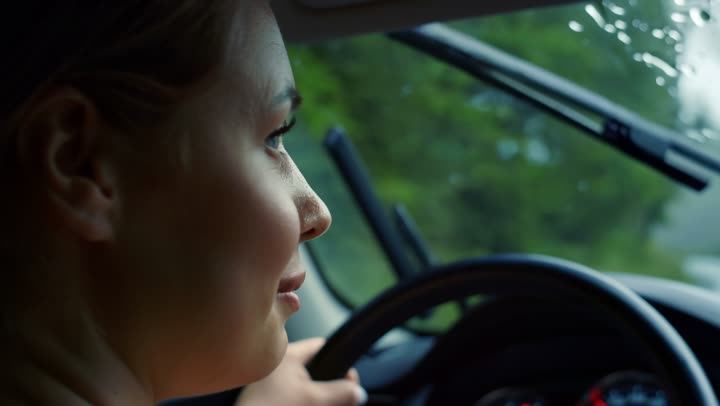
Above: a woman driving, seen through the side window, from a clip made with Alibaba's Wanx. It isn't a lip-sync fake, but it shows how realistic generated faces now are; the clues have moved from the obvious to the small. Our video model scored it 99% AI.
Check the source and the voice
- Find the original footage. Lip-sync fakes are built on real clips. Search a frame with Google Lens or search the event; the original press conference or interview usually exists, with different words.
- Listen for a cloned voice. A voice that's slightly flat, too clean for the room, or with odd pauses. Our guide to AI voices has more.
- Ask whether they'd say it. A famous person recommending a little-known investment app or making an outrageous statement only in a shared clip is a red flag on its own.
Quick answers
What is a lip-sync deepfake?
A real video with new audio and an AI-edited mouth, so the person appears to say words they never said.
Can AI detect lip-sync deepfakes?
Detectors can flag many of them, especially when the voice is also synthetic or the mouth area shows editing artefacts. Small, high-quality edits on compressed video remain hard for everyone.
Is AI dubbing a deepfake?
Technically it uses the same methods. Openly labelled dubbing for translation isn't deceptive; the problem is undisclosed edits that change what someone said.
Check a clip
Paste the link or upload the video on crackly-ai.com. Our scan looks at the picture over time and runs a voice check, and shows the reasons behind its answer.